
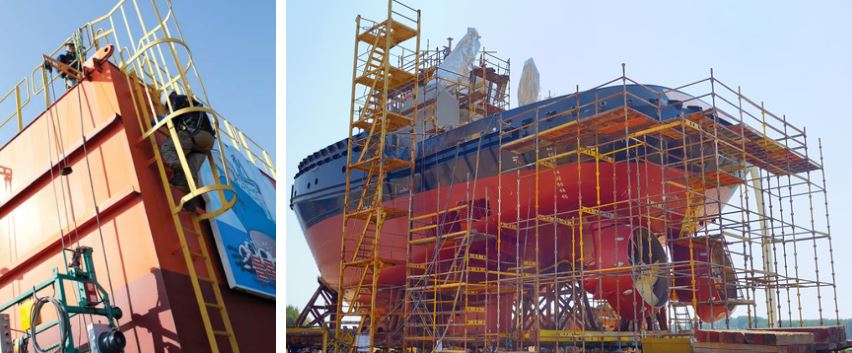
The world’s leading shipbuilding industry must also lead the world in safety.
South Korea’s shipbuilding industry is widely recognized as a global leader in technology and order volume. However, despite these achievements, the level of industrial accidents in shipbuilding remains significantly higher than in many other industries.
To sustain the status of a global shipbuilding powerhouse, employers, supervisors, and workers must unite with a shared commitment to reducing workplace accidents across the industry.
.
.
.
.
World-Class Technology, Bottom-Tier Accident Rates
The accident rate in the shipbuilding industry stands at 1.20%, which is about 1.74 times higher than the overall industry average of 0.69%, and approximately 1.12 times higher than the average across the manufacturing sector.
In other words, while South Korea ranks first in shipbuilding technology and orders, its industrial safety performance still lags behind.
Compared to other industries, shipbuilding workers are more frequently exposed to harsh and hazardous working conditions. Over 70% of shipbuilding workplaces employ fewer than 50 workers, meaning many are small subcontractors with relatively limited investment in occupational safety and health compared to large corporations.
Additionally, the industry relies heavily on non-regular workers. Many newly hired, less-experienced workers are pushed into so-called “rush jobs” to meet production deadlines, which significantly increases the risk of accidents. Combined with long hours and night shifts, the danger becomes even greater. In some cases, workers begin tasks without receiving even basic safety and health training.
Shipbuilding also involves complex processes that are difficult to automate. As a result, traditional accidents—such as falls, entanglement, collisions, fires, and explosions—continue to occur repeatedly. Unique work methods and environments further complicate systematic safety management.
Given these characteristics, reducing accidents in shipbuilding requires each stakeholder—employers, supervisors, and workers—to fully carry out their respective roles and responsibilities.
.
.
.
.
.
Roles and Responsibilities for Safety in Shipbuilding
1. The Role of Employers
Employers must create a work environment where employees can perform their tasks safely and demonstrate a strong commitment to improving safety awareness. This commitment should be clearly reflected in management policies and safety objectives.
In practice, a clear pattern can be seen among subcontractors working under large shipyards. Those with exceptionally low accident rates often share one common trait: the employer arrives at the site before workers each day, personally inspects the workplace, and actively oversees high-risk tasks.
These workplaces consistently experience far fewer accidents. This clearly shows how critical employer involvement and leadership are. When safety is treated as the highest priority and a strong safety culture is continuously reinforced, industrial accidents can be significantly reduced.
.
.
2. The Role of Supervisors
Many shipbuilding accidents stem from unsafe worker behavior, often compounded by insufficient supervision.
To prevent this, supervisors must clearly understand and fulfill their safety and health responsibilities. Through risk assessments, enforcement of standard operating procedures, and effective on-site communication, supervisors can help create a safer working environment.
Supervisors should continuously develop the ability to identify workplace hazards and provide training tailored to workers’ skill levels. Based on this knowledge, detailed and practical action plans must be established to address safety issues on-site.
For example, new workers assigned to painting operations must receive training on specific risks such as fire and explosion hazards. However, in reality, training is often generic or ineffective due to a lack of safety expertise.
Effective accident prevention requires supervisors to lead practical, site-specific training that helps workers recognize risks and fosters a strong culture of safe work practices.
.
.
3. The Role of Workers
Are workers simply expected to “do the job”?
Experience from safety support programs shows that most workers are not unaware of risks—they often choose to ignore them.
It is heartbreaking to see families devastated by accidents caused by momentary carelessness. Thoughts like “I’ve never been injured before” or “I have over 10 years of experience” can become the most dangerous mindset.
Although about 58% of accidents involve workers with less than one year of experience, fatal accidents occur regardless of years on the job. This indicates that ignoring procedures and safety rules—whether by skipping steps or disregarding instructions—leads directly to serious accidents.
Statistics show that only about 3% of accidents are caused by equipment defects. The vast majority result from unsafe behavior and failure to follow safety rules. Therefore, workers must strictly follow work sequences, methods, and safety procedures.
To return home safely to your family every day, it is essential to replace a “hurry-hurry” mindset with a habit of “work carefully.”
.
.
.
.
.
.
Reducing Accidents by Reflecting the Nature of Shipbuilding
Industrial accidents cause irreversible human and material losses, reduce productivity, and weaken national competitiveness. Compared to advanced countries, South Korea’s accident prevention capability still needs improvement.
Achieving meaningful change requires strong commitment from management, enhanced supervisory roles, and strict compliance with safety rules by workers themselves.
Safety management must also evolve alongside new technologies and construction methods. Past experience with container ships or bulk carriers alone is insufficient to ensure safety in LNG or LPG carriers and offshore structures. New processes—such as the use of inert gases—require updated and specialized safety procedures.
To maintain its status as a world-leading shipbuilding nation, South Korea must also achieve world-class safety standards.
Employers must build comprehensive safety management systems that include subcontractors, while supervisors must strengthen practical, on-site training. When these efforts truly take root, workers will recognize risks and act accordingly—leading to a clear and lasting reduction in shipbuilding accidents.
.
.
.
Shipbuilding Accidents and Prevention Measures
Painting Operations Safety
Key Hazards
-
Fire risk when paint or thinner containers are left open
-
Electric shock due to damaged cable insulation
-
Fall hazards when working at heights or on slopes without safety nets
-
Slips and trips caused by poor housekeeping
.
Prevention Measures
-
Seal all remaining solvents in proper containers after work
-
Ensure ladders are securely fixed during outdoor painting
-
Thoroughly inspect work platforms and manhole covers
-
Install safety nets when working at elevated locations
-
Maintain strict tool and material housekeeping
.
.
.
.
Outfitting Operations Safety
Key Hazards
-
Burn injuries from pipe rupture during work
-
Cuts from tools during mechanical outfitting
-
Finger entrapment during bolting operations
-
Fall hazards when working on blocks without safety nets
.
Prevention Measures
-
Inspect welding areas and equipment thoroughly
-
Sort pipes after painting according to assembly sequence
-
Support relocated pipes properly during module assembly
-
Transport outfitting materials as close as possible to installation points
-
Install safety nets during block work
.
.
Fitting and Welding Operations Safety
Key Hazards
-
Falls caused by unstable posture when carrying tools at height
-
Fire or explosion due to gas leaks or electric shock
-
Suffocation risk in confined spaces without ventilation
-
Impact injuries from falling objects
.
Prevention Measures
-
Install gas lines at safe distances
-
Use tools appropriate to the task and location
-
Provide proper lighting and ventilation in confined spaces
-
Check for flammable materials below and around work areas
-
Implement fall protection measures for elevated work